Showing posts with label satire. Show all posts

Saturday, May 3, 2025

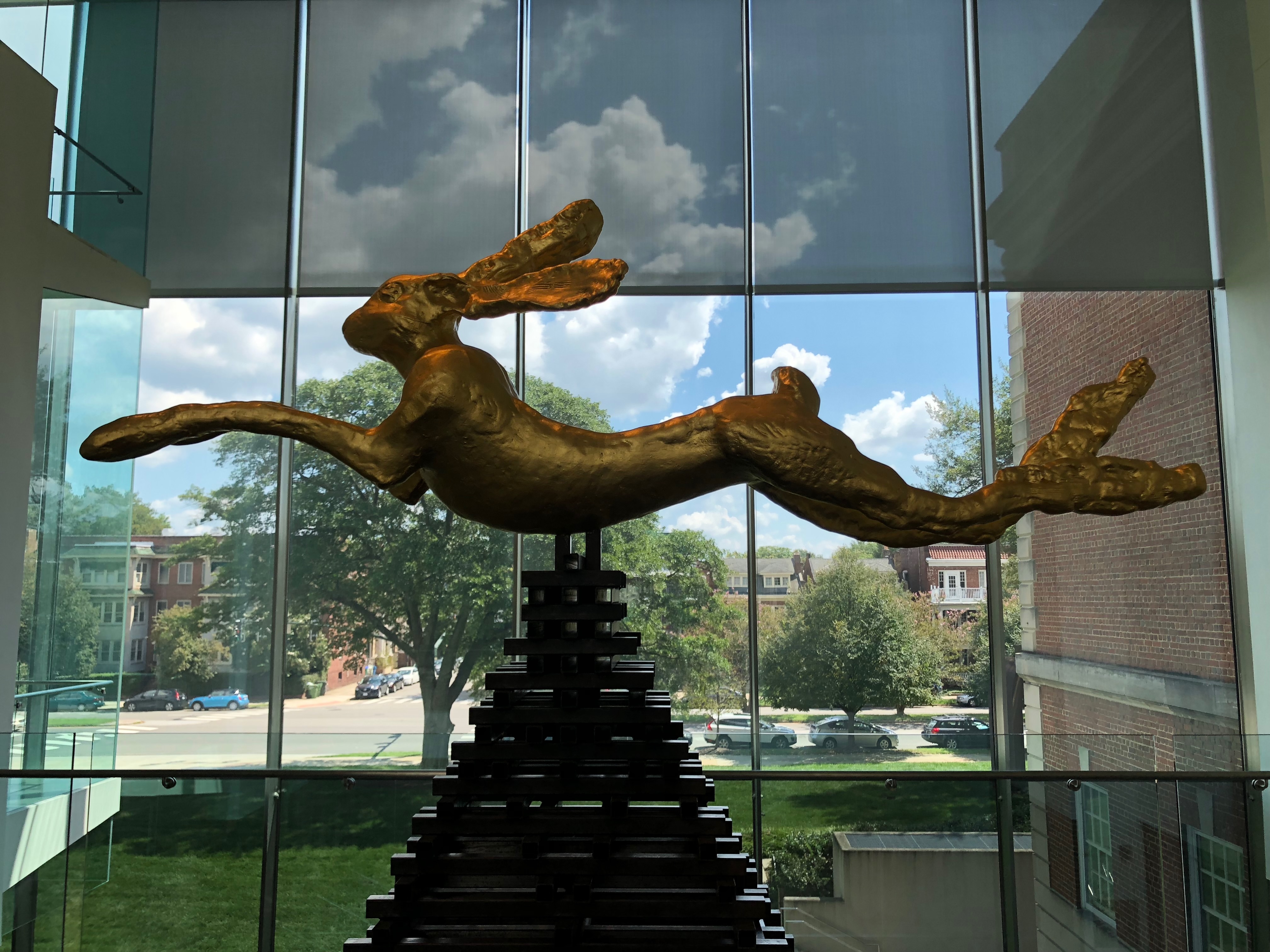
Art: The Hare Apparent: Flanagan’s Bronze Insurgency


What do you get when a Welsh sculptor trades in the solemnities of stone and steel for a gold-leafed, gravity-defying rabbit that looks like it escaped from a Monty Python fever dream? You get Large Leaping Hare, a bronze middle finger to every brooding, bombastic monument that ever tried to look “important.” Barry Flanagan didn’t just sculpt a leaping hare—he launched a cultural sneak attack on the idea that Serious Art must wear a frown and weigh six metric tons. Here, his hare doesn’t sit still, doesn’t ponder existence, and certainly doesn’t care for your tortured metaphors. It vaults through the air with the unbothered elan of a champagne-soaked ballet dancer who’s ditched rehearsal for good.

At a glance, the piece feels lighthearted. But don’t be fooled. That levity is a Trojan horse—inside, you’ll find a robust challenge to modernism, minimalism, and the postwar urge to make sculpture as fun as a concrete parking garage. Flanagan’s hare mocks austerity with motion, mocks mass with poise, and mocks permanence with a wink. It’s like someone cast Bugs Bunny as a Greek god and no one told the critics. And best of all, it dares you not to smile. Spoiler: you’ll fail.

Flanagan: The Trickster Among Titans

Barry Flanagan started his career with sand, Hessian sacks, and other materials more suited to a beach holiday than a gallery—an enfant terrible of London’s art schools in the 1960s. Educated at St. Martin’s (when it still meant something), Flanagan quickly grew bored of minimalist orthodoxy, that oppressive, joyless cult that demanded silence and reverence. He found those demands both creatively suffocating and laughably pompous. And so, like any good provocateur, he made mischief his medium. Enter the hare.

The hare—an animal associated with fertility, madness, and the lunar cycle—became Flanagan’s totem of rebellion. He sculpted them in poses worthy of a Fellini film: boxing, leaping, playing instruments, and generally looking like they’d stolen the keys to the kingdom of art history. These were not quaint bunnies—they were Dadaist pranksters on amphetamines. And Flanagan, far from retreating into conceptualism or political didacticism, doubled down on a visual language rich with myth, movement, and above all, humor.

Hop Forward or Stand Still? The Contextual Tension

Large Leaping Hare was conceived in an era when sculpture was still wrestling with its postwar identity. In the decades following World War II, artists had all but declared the death of figuration and narrative. Sculpture became synonymous with rusting steel, welded severity, and enough abstraction to alienate a NASA engineer. Then along comes Flanagan with a hare the size of a small car, doing a gymnast’s split across a plinth that looks suspiciously like a ziggurat made from black licorice.

The 1980s art world didn’t quite know what to do with him. Was this sculpture “about” something? Was it ironic? Was it… British performance art in bronze? None of that mattered to Flanagan. He wasn’t interested in offering a TED Talk in alloy. Instead, he summoned the age-old power of storytelling and movement—except his epic wasn’t Homeric, it was haredic. The result was a figure so gleefully kinetic it practically airlifts the entire gallery out of its own navel.

The Joke’s on Gravity

What does it mean when a hare flies and never lands? Maybe it’s about transcendence. Maybe it’s about futility. Or maybe, just maybe, it’s about reminding us that the human condition isn’t as noble or tragic as we think—it’s ridiculous. Look at us: throwing up glass cathedrals to capitalism, only to put a cartoon mammal front and center as if it’s the Second Coming. And yet, there’s a kind of grace in that absurdity. Because if art doesn’t leap over its own self-importance now and then, it’s just another lump of bronze pretending to be wise.

So here’s the real question: What are you doing with your life that’s more airborne, more radiant, and more unapologetically weird than this hare?

#LeapIntoIt #FlanaganFlicksTheCanon #HighArtHare #BarryDidItBetter #GoldIsTheNewIrony #MuseumMischief #HareToBeDifferent #JumpStartTheEstablishment #ArtThatDoesn’tSitStill


#LeapIntoIt #FlanaganFlicksTheCanon #HighArtHare #BarryDidItBetter #GoldIsTheNewIrony #MuseumMischief #HareToBeDifferent #JumpStartTheEstablishment #ArtThatDoesn’tSitStill

Friday, May 2, 2025

Film: Wizards (1977): A Psychedelic Misfire from the Great Beard of Bakshi

If Yellow Submarine crashed headfirst into a fascist propaganda reel and the wreckage was animated on a pile of napkins during a three-day speed bender, you might get Wizards. Ralph Bakshi’s nuclear fairytale about magic versus technology is like a lava lamp with opinions. It wants to be Tolkien, but it ends up feeling more like a high school mural painted by that one guy who swears Cheech Wizard is deep. For every ounce of visual bravado, there are three cups of narrative soup that have boiled over into incoherence.

The Making of a Messianic Mushroom Trip

This was Ralph Bakshi’s first foray into fantasy—after having thoroughly scandalized animation with Fritz the CatHeavy Traffic, and Coonskin, all films best described as “X-rated Looney Tunes for people who’ve been kicked out of art school.” Bakshi wanted to show he could do “clean” fantasy. So he made a film where fairies get kidnapped, the robot is named Peace for irony, and a Nazi film projector becomes the ultimate weapon. Apparently, it’s a PG-rated allegory about the Holocaust. Yeah. Nothing says “family fun” like elves storming Normandy.

The original title was War Wizards, but George Lucas was releasing some flick called Star Wars and asked Bakshi to change it. In exchange, Lucas gave Mark Hamill a few minutes off from fighting Sith Lords to get his head blown off as a cartoon fairy prince. Fair deal, I guess. Maybe too fair. If this movie had stayed War Wizards, people might’ve thought it was a Saturday morning cartoon and been spared the trauma.

Cast of Dozens, Budget of Dimes

The animation? Imagine Fantasia as directed by someone whose idea of storyboarding was “what if LSD had a storyboard?” The horse-beasts have two legs because animating four was expensive. There were no pencil tests. The final product was the first draft. Rotoscoping saves the day in the third act when Bakshi runs out of money and composure. That climactic battle? It’s stock footage from Alexander Nevsky and Patton with silhouettes slapped over it like a Soviet acid trip.

Bob Holt voices Avatar by imitating Peter Falk with a head injury. David Proval is Peace, the robot assassin turned space hippie. Susan Tyrrell, who later regretted not being credited as the narrator, probably made the right call. And then there’s Blackwolf, the villain who plays Nazi propaganda films to psych up his mutant goons. That’s right: in this movie, Goebbels is a literal wizard. Subtlety? Bakshi left it in Coonskin.

Half Cult, Half Confusion

Upon release, the critics couldn’t decide if it was brilliant or brain-damaged. Gene Siskel called it “good-looking, but not magical.” Variety called it “confusing.” The fans, however—God bless their lava-lamp hearts—turned it into a midnight movie classic, the kind that plays to crowds in basements full of incense smoke and ironic mustaches. It developed a legacy as a “lost masterpiece,” mostly by people who hadn’t seen it since they were stoned in 1983.

Bakshi always intended Wizards to be a trilogy, which is adorable. A sequel was teased, a graphic novel floated, and even a potential movie in development hell. But, like Avatar’s magic, those hopes were stuffed up a sleeve and never reappeared. The Blu-ray came with a 24-page book that probably explains the plot better than the actual film.

Magic vs. Machines vs. the Audience’s Patience

In the end, Wizards is a relic—bold, bizarre, and ultimately buried under the weight of its own symbolism. It’s not a movie so much as a manifesto scribbled in crayon. You might love it. You might hate it. But you’ll never forget it, no matter how hard you try. Like an unwanted tattoo or a bad trip at Burning Man, it lingers.

⭐️⭐️ (2/5)

#TheyKilledFritz #CheechWizardCosplay #NazisInMyCartoons #RalphBakshiDontMissJustReloads #WizardsWasAChoice


Thursday, May 1, 2025

Film: Les Girls (1957): A Cha-Cha of Charm and Confusion


You ever go to a dinner party where the guests are stunning, the cocktails are cold, and the conversation is… suspiciously inconsistent? That’s Les Girls, George Cukor’s glitzy 1957 musical comedy where the sequins shine, the truth doesn’t, and everyone’s memory of the evening is just a little off. This was MGM’s attempt at staying classy in an era when the musical was slipping into self-parody, and instead of champagne, they served us a lukewarm martini with a lipstick-smudged rim.

Truth, Memory, and a Studio in Denial

The story started with a simple article in The Atlantic—a wistful recollection from Constance Tomkinson about her cabaret days in Paris. Screenwriter Vera Caspary, never one to let nostalgia go un-complicated, transformed the memoir into a courtroom tangle about the unreliability of memory and the fragility of reputation. Then John Patrick, an Oscar-winner for Teahouse of the August Moon, polished the script into something approximating farce—but instead of razor-sharp satire, we got a swirl of shrug-worthy revelations and confused characters in glittery bodices.

Meanwhile, producer Sol C. Siegel and director George Cukor had dreams of on-location filming across Europe—Paris! Lisbon! Moscow!—but MGM’s finance department grounded them quicker than you can say “studio austerity.” So we’re left with soundstage Paris, which isn’t fooling anyone, and backdrops that look like Josephine Baker might’ve tripped over them in 1930.

And who else to bless this confusion with music than Cole Porter? The film would be his final complete film score and, honestly, it shows. While Porter’s lyrics still sizzle with wordplay and innuendo, they often feel stitched together from cocktail napkins left over from Kiss Me, Kate. There’s no “Begin the Beguine” magic here—more like “Begin the Litigation.”

A Revue of Missed Chances and Surprise Deliveries

Les Girls also plays like a musical chairs of mid-century leading ladies. Originally, the roles were meant for a global glamor trifecta: Cyd Charisse (American), Leslie Caron (French), and Kay Kendall (British). But Charisse ditched the project for Silk Stockings—because apparently one musical with questionable sexual politics was enough for her that year. Mitzi Gaynor, all cheerful tap and no menace, stepped in.

Then Caron bailed, leading to the film debut of Finnish ballerina Taina Elg, who had just given birth when she landed the role of Angele. Oh, and Kendall? She wavered on signing, too, but eventually stayed. That meant Elg was tested for both Kendall and Caron’s roles before finally landing one—proving that in MGM musicals, talent was less important than availability and a decent waistline.

Gene Kelly, the MGM warhorse himself, was also ready to clock out. Les Girls marked the end of his contract with the studio, and the weariness shows. He dances like a man who knows it’s all ending—elegantly, efficiently, but without the revolutionary spark that lit An American in Paris or Singin’ in the Rain. His Barry Nichols is charming but oily, a man who lies to women for their own good and still gets a curtain call. That Joy forgives him at the end says less about romance and more about the screenwriter needing to wrap this thing up.

Rashomon in Rhinestones

The film’s central conceit—that memory is unreliable and everyone lies when love and fame are involved—is clever in theory. In practice, it’s a confusing carousel of flashbacks, costume changes, and contradictory narration that makes Rashomon look like an episode of Judge Judy. Sybil writes a scandalous memoir. Angele sues her. Both tell opposing tales about who bedded Barry and who passed out drunk next to a gas leak.

Enter Barry with the “truth,” which, unsurprisingly, paints him as the noble puppet master of women’s destinies. He confesses he faked a heart condition to get the girls to quit dancing so their men could marry them. Joy finds him appalling—until she doesn’t. The film ends with a wink and a shrug, as if everyone agrees that the past is best left in soft focus, with a big musical number behind it.

Champagne Dreams, Soda Water Returns

Critically, Les Girls did just fine. It won the Academy Award for Best Costume Design (Orry-Kelly’s frocks do all the heavy lifting) and picked up two more Oscar nods for sound and art direction. It also snagged a Golden Globe for Best Musical or Comedy, though that might have been a nod to nostalgia more than substance. Kay Kendall and Taina Elg shared a Best Actress win, which feels like an award given just for surviving the rewrites and corsets.

Financially? Not so great. Despite respectable grosses—$2.4 million domestically, $1.45 million overseas—the bloated production budget left MGM nursing a $1.6 million loss. Apparently, even dressing Gene Kelly in silk smoking jackets doesn’t guarantee ROI. Today, the film floats in that weird bubble of cult nostalgia, beloved by costume enthusiasts and musical completists but rarely watched by actual audiences. A proposed sequel, Les Boys, never happened (a mercy, perhaps), though it did spawn a short-lived NBC sitcom, Harry’s Girls, proving even mediocrity can have long legs if they’re in fishnets.

A Last Waltz, Half-Remembered

Les Girls is a relic of a genre out of steam, a final bow for a studio, a star, and a composer who had once made musicals feel like dreams. There’s beauty here—Kay Kendall’s brilliance, Porter’s sly lyrics, the visual dazzle—but it’s all wrapped in a structure that collapses under its own cleverness. If you want elegance, stick with Gigi. If you want choreography, go back to Singin’ in the Rain. But if you want a mildly amusing time capsule where everyone lies and no one changes—well, Les Girls will give you a few winks and a knowing shrug.

⭐️⭐️⭐️ (3/5)

#LesGirls1957 #KayKendallForever #GeneKellyLastDance #ColePorterExitStageLeft #RashomonButWithJazzHands #MGMMusicals #SequinsAndSubpoenas


Saturday, April 26, 2025

Art: From Little General to Big Problem: How Napoleon Crowned Himself King of the World (or Tried To)


Once upon a time, a scrappy little Corsican named Napoleon Bonaparte decided that being First Consul just wasn’t enough. Nope. Titles like “hero” or “savior of the Republic” sounded too much like something you could lose at halftime. Napoleon wanted something permanent, something shiny. So what does he do? He grabs a gold leaf wreath, swipes a scepter, and basically cosplays as Caesar. Hence we get “Napoléon Ier en costume du Sacre”, painted in 1805 by François Gérard — a man who knew how to make tyranny look like a GQ cover shoot.

François Gérard, for those keeping score at home, was the artist you called when you needed to look good enough to rewrite constitutions. A student of Jacques-Louis David (the Beyoncé of Revolutionary art), Gérard perfected the fine art of painting your favorite dictator in a way that made him seem both godlike and ready for a cologne ad. Gérard gave Napoleon this dazzling portrait, glammed up in white satin, crimson velvet, and enough gold embroidery to wallpaper the Louvre. It was all calculated. You weren’t supposed to see a man who clawed his way to power—you were supposed to see destiny in a fur-trimmed bathrobe.

And yet, let’s not kid ourselves. This was a costume party of the most dangerous kind.

The historical context? Simple: Napoleon had just made himself Emperor after charming, bullying, and shooting his way through Europe. He even dragged Pope Pius VII to Paris for the coronation, only to snatch the crown and slam it on his own head — because when it comes to narcissism, why let God have the last word? Gérard’s portrait captures this new reality: one man, standing alone, swathed in symbols of legitimacy he bestowed upon himself, daring anyone to challenge the theater he just made real.

Here’s the uncomfortable meaning staring back at us: autocrats don’t announce themselves with jackboots and evil laughs. They show up draped in honorwreathed in tradition, and holding scepters. They redefine reality through sheer pageantry — and they dare you not to clap.

In 1805, people gazed at this painting and saw an emperor.

Today, if we’re not careful, we’ll look around and see a hundred more — dressed differently, but wearing the same smug grin under different crowns.

So the real question is: How long will it take before we stop mistaking costumes for character?

#CrownedByHimself #NapoleonComplex #HistoryIsWarningNotBlueprint #VelvetTyrants #ArtAsPropaganda #GérardKnew #EmperorsWithoutClothes

Friday, April 25, 2025

Art: Would You Trust This Man with a Republic?

Ah, Napoleon as First Consul. It’s the visual equivalent of a rebranding campaign for a guy who’s already halfway through a hostile takeover. Painted by Andrea Appiani—a man who knew exactly which side of the easel history was being written on—this portrait doesn’t just depict Napoleon Bonaparte. It seduces you. It says, “Look at this man. He’s not a dictator. He’s a visionary. And he irons his cuffs.”

Let’s be clear: this isn’t just oil on canvas. This is myth-making in real time.

Andrea “Spin Doctor” Appiani

Andrea Appiani, the Italian court painter who gave Napoleon this imperial glow-up, was not some neutral observer. He was a state-sanctioned brushman with a job: make the up-jumped Corsican artillery officer look like the second coming of Augustus. And damn if he didn’t deliver. Appiani gave us a Napoleon who doesn’t sweat, doesn’t blink, and most definitely doesn’t ask permission.

Appiani was the guy you called when you needed to look both benevolent and bulletproof. Think of him as the 19th-century version of a high-end Instagram filter—except the stakes were slightly higher than likes and engagement metrics. He wasn’t painting what was. He was painting what the regime needed you to believe.

Liberty’s Last Stand—Now in Velvet

This was painted in 1801, fresh off the coup of 18 Brumaire, when Napoleon decided democracy was overrated and wrote himself in as First Consul of France. You know, just temporarily. Just until things stabilized. Just until the Republic could get its feet under it. Spoiler alert: the Republic didn’t make it. Napoleon did.

And here, in this portrait, is the con: the soft jaw, the far-off gaze, the not-so-subtle Roman stylings wrapped in military chic. It’s all designed to scream “restoration” while whispering “absolute power.” He’s not brandishing a weapon—he’s accessorizing with one. Because real power doesn’t shout. It poses.

This wasn’t leadership—it was set design. The revolution had left France exhausted, paranoid, and hungry for order. Napoleon offered calm, structure, and the soothing promise that everything would be okay… if they just gave him everything.

The Original “I Alone Can Fix It” Vibe

The genius of this painting is that it doesn’t shout revolution—it murmurs reassurance. It gives you the fantasy of strength wrapped in a bow of calm authority. He’s not a warlord—he’s a problem-solver. A peace-bringer. A First Consul, not a future emperor. Nothing to see here, citizens. Just a competent man with a good tailor and a backup plan for liberty.

But let’s not miss the real trick. This painting isn’t just a record of a moment—it’s a warning. Because every populist strongman wears a version of this uniform. They promise greatness, restore “order,” and smile just long enough to close the door behind you. And when they do, it won’t be a guillotine that ends the republic—it’ll be applause.

So, here’s the question:

What makes us fall for the strongman every time—his promises, or the way he looks in a sash?

#PaintedPropaganda #AppianiKnew #NapoleonGlowUp #FirstConsulFirstLie #VelvetCoup #HistoryIsRepeatingWithBetterLighting #RepublicOnTheRocks #AutocratAesthetic #DemocracyInDisguise #StrongmanSeasonReturns

Friday, April 18, 2025

Art: What Happens When the Dog is the Most Normal One in the Room?

Step aside, da Vinci. Move over, Renoir. Because 2 Girls and a Dog by Ndidi Emefiele just walked into the art world wearing a bath towel and oversized glasses like it owns the place—and honestly, it kind of does.

This isn’t your grandmother’s portraiture. No soft lighting. No delicate teacups. Just two gloriously melanated girls—one peering through Coke-bottle spectacles, the other mid-eyeroll tongue flick—flanking a dog who looks like he’s contemplating the futility of being the only sane creature in the bathroom.  It’s domestic surrealism on Adderall.

👁️‍🗨️ Meet Ndidi Emefiele: The Queen of the Unbothered Gaze

Ndidi Emefiele, Nigerian-born and London-trained, paints like she’s got one hand in tradition and the other in the emoji drawer. Her women? Fierce. Her fabrics? Loud. Her sense of satire? Sharper than a broken wine glass at brunch. She stitches together pop culture, African textiles, and enough attitude to make Warhol blush, creating portraits that refuse to smile politely for the camera—or for anyone, for that matter.

She’s not just painting women. She’s painting back at a world that has spent centuries cropping them out of the picture.

🌀 Historical Context: Postcolonial Funk Meets Bathroom Tile

In a world still detoxing from the colonial visual diet (read: stiff European portraiture and noble suffering), Emefiele throws out the rulebook and replaces it with bold color, collage, and personalities big enough to knock the Mona Lisa off her smug little hook. 2 Girls and a Dog is a postmodern rejoinder to everything portraiture forgot: joy, absurdity, chaos, and women who look like they’ve just told you off—in three languages.

The setting? A bathroom, maybe. Or maybe the afterlife of gendered labor and beauty rituals. The towel says self-care; the smirk says “don’t get cute.” And that dog? He’s the stand-in for us, the viewer—brought into the scene to witness, to wonder, and probably to mind our own damn business.

🎯 The Meaning: A Middle Finger with Manicure

This piece isn’t just about being seen. It’s about controlling the terms of that seeing. Through warped proportions and wild prints, Emefiele tells us: Black women are not waiting for permission to be playful, or powerful, or pissed off. They’re doing it all at once. And the striped chair legs are just along for the ride.

So ask yourself: When was the last time you sat still long enough to laugh at the ridiculousness of being “understood”?

Because sometimes the deepest truth comes wrapped in a towel, flanked by sass, and sitting next to a dog who knows exactly what’s going on.

#NdidiEmefiele #ContemporaryArt #Afrofuturism #PostcolonialPortraiture #BlackGirlMagic #ArtWithAttitude #DogDaysOfRepresentation #SatireInAcrylic #ArtWorldShakeup #2GirlsAndADog

Thursday, April 17, 2025

Art: Mirror, Mirror on the Floor—Who’s the Blackest of Them All?

What do you get when Edo-period Japan crashes headfirst into BET’s 106 & Park circa 2002, and the fallout lands on a woman with a mirror, a tube of lip gloss, and a soul full of questions? You get a3 blackface #20, iona Rozeal brown’s gloriously confounding, culturally spliced masterpiece. This isn’t just art—it’s a visual remix of appropriation, identity, beauty, and that ever-insatiable desire to wear someone else’s culture like a cute coat on a cold day.

Rozeal, a classically trained painter with the wit of a satirist and the hand of a master printer, saw something peculiar in the early 2000s: Japanese Ganguro and Yamanba girls—teens who darkened their skin, donned frosty white lipstick, and blasted Missy Elliott while cosplaying as Blackness. It wasn’t homage. It wasn’t mockery. It was… complicated. So what did Rozeal do? She didn’t cancel anyone. She made art about it—and in doing so, flipped the script.

This piece isn’t content to shout “cultural appropriation!” and drop the mic. No, rozeal makes it messier. She borrows the visual language of ukiyo-e—those elegant woodblock prints of courtesans and geishas—to depict a woman of unmistakable African descent, wrapped in kimono sleeves and camouflage, putting on her face like armor. She’s regal, composed, and self-made. And yeah, those are UGG boots.

Every detail is a conversation: the Afro puffs like twin planets of pride; the fur collar that screams “Y2K Fabulous”; the cosmetics scattered around her like sacred offerings to the gods of curated femininity. rozeal isn’t asking for your approval. She’s showing you the cross-cultural soup we’re all swimming in—and asking whether anyone remembered to read the recipe before seasoning it with someone else’s history.

She reminds us that pop culture doesn’t just travel. It mutates. The globalized Black aesthetic, once born of struggle, becomes a lookbook in Shibuya. And in this tangled web of admiration, commodification, and identity tourism, Rozeal doesn’t take sides—she holds up a mirror. And like the woman in her painting, we all have to look.

So the real question is:

When you admire someone else’s reflection—do you even see your own anymore?

#IonaRozealBrown #BlackfaceSeries #CulturalHybridity #AppropriationOrAppreciation #ModernUkiyoe #GanguroGirls #AfroAsianFusion #BlackArtMatters #WhoOwnsCulture #ContemporaryPortraiture #MirrorMirror #Y2KMeetsEdo

Wednesday, April 16, 2025

Art: “Mr. America”: The Cowboy, the Corpse, and the Collage of Lies

So here’s a fun question:

What happens when you take the American Dream, skin it alive, run it through a meat grinder of racial hypocrisy, stuff it into a too-tight Sunday suit, and slap a Stetson on top?

You get Mr. America—or as Benny Andrews might have called him, “Uncle Sam’s hungover uncle.”

Painted by the ever-underrated, always-unapologetic Benny AndrewsMr. America doesn’t so much “depict a man” as it unpacks the myth of one, limb by stitched-together limb. With oil, canvas, fabric, and all the rage of a Southern-born Black man who saw the American promise and knew damn well who it was not for, Andrews crafts a figure whose face looks like it’s been hit by Manifest Destiny, Reconstruction, and a Nixon speech—simultaneously.

This is not a painting that flatters. It confrontspeelscracks, and calls bullsh*t.

Andrews, born in 1930 in segregated Georgia, was the son of sharecroppers and a lifelong fighter. When he wasn’t turning galleries into battlegrounds for civil rights (hello, Black Emergency Cultural Coalition), he was stitching together images like this—portraits of the nation’s underbelly wearing its Sunday best. If Norman Rockwell painted what America thought it looked like, Benny Andrews painted what it felt like to live here on the wrong side of a parade float.

Take a look at that face. Half melting, half screaming, all mask. Mr. America isn’t a man. He’s a construct. A Frankenstein monster sewn from lies about equality, stitched with barbed wire, and shellacked in patriotism. That hat? A caricature of old-school Americana. That suit? Straight from a funeral—maybe his own. Maybe ours.

The beauty of this piece lies in its ugliness. It’s grotesque, yes—but also eerily honest. And let’s be clear: Andrews knew what he was doing. He wasn’t trying to shock. He was trying to wake you the hell up.

In a nation still addicted to slogans, soundbites, and smiling statues, Benny Andrews made a monster—and dared to call it us.

So, the question is: If this is Mr. America, who’s holding the brush now?

#ArtThatBites #BennyAndrews #MrAmerica #AmericanDreamOrNightmare #ArtAsResistance #CollageAndCritique #MixedMediaMeltdown #FaceOfTheNation #MuseumOfTruth #ArtHistoryUnmasked

Monday, April 14, 2025

Art: “NEGROSCHOLARshit”: The Art of Getting Your PhD in GTFO

Fahamu Pecou doesn’t knock politely. He kicks down the mahogany-paneled door of academia, lights a cigar with your tenure letter, and poses shirtless under The Journal of Contemporary Culture header like a cover model from GQ: Grad Qualms Edition. His 2011-ish piece “NEGROSCHOLARshit” isn’t just art — it’s a full-body side-eye to a culture that treats Black intellect like it’s only real when it’s wearing elbow patches and quoting Baldwin… preferably in a British accent.

Let’s talk visuals. A ripped, melanated scholar (read: pecs and Pecou) smirks under a mortarboard while clutching academic texts like they’re gym equipment. He’s got white shades, a cigar, and swagger so thick it needs a bibliography. Spray-painted across the bottom in punk-rock defiance? NEGROSCHOLARshit. Say it again. Slowly. Savor the sting.

This isn’t graffiti — it’s a reckoning. A deliberate defacement of the Ivy Tower’s velvet ropes. A refutation of every panel discussion that wants “diverse voices” but clutches its pearls when the voice doesn’t come in a soothing NPR whisper.

Pecou, an Atlanta-based artist and philosopher disguised as a hypebeast, has long treated the canvas like a boxing ring. He jabs at respectability politics. He swings at fetishization. And he body-slams the idea that scholarship has to look, sound, or behave a certain way to be valid. A graduate of the “yes, AND” school of Black expression, Pecou plays both the griot and the trickster. He’s been known to wear a kufi with Jordans. He uses paint the way Baldwin used prose — as a tool of resurrection, resistance, and high-voltage satire.

But don’t let the humor fool you. NEGROSCHOLARshit hits because it’s true. The academy still struggles to make room for Black knowledge that doesn’t conform to its own image of enlightenment — knowledge that’s loud, embodied, brash, vulnerable, and complex. This piece is about the exhaustion of code-switching. It’s about the insult of being “the only one in the room.” It’s about reclaiming the podium without needing to apologize for the beat in your chest or the bass in your voice.

The real kicker? He’s holding books — the very symbols of that sought-after legitimacy — like he just ripped them off the shelf after they refused to cite him. This is erudition with attitude. A dissertation wrapped in defiance.

So here’s the question:

What if the most brilliant scholar in the room is the one the institution keeps trying to shush?

#NegroScholarShit #FahamuPecou #BlackIntellectUnbound #DisruptTheDiscourse #AcademicDrag #CitationResistant #BlackExcellenceUnfiltered #DecolonizeEverything #SmartAndShirtless #SyllabusReparations #GraduatedWithSmoke #ScholarAesthetics #RageInTheMargins #FootnotesFromTheUnderground #NoMoreRespectability #TenureThis #ThisIsMyThesis

Tuesday, April 8, 2025

Books: A 3-Star Review of Henderson the Rain King


Let’s be honest. When you dive into Henderson the Rain King, you’re not reading for thrills, chills, or plot twists. You’re signing up for a ride in a beat-up Land Rover packed with midlife crisis, metaphysical tailspins, and a man with enough existential baggage to bankrupt Delta Airlines. Yes, Saul Bellow’s 1959 acid-drenched safari into the soul of a rich, spiritually constipated American is hailed as “comic” and “philosophical,” but only if your idea of comedy involves dead cistern frogs and your philosophy professor wearing khakis and screaming “I want, I want, I want” into the void. Three stars. That’s it. One for ambition, one for Dahfu, and one for the sheer audacity of making white-guy ennui into literature.

Bellow in the Bush

By the time Bellow unleashed Henderson upon the masses, he was already carving out his Mount Rushmore mug in American letters. The Adventures of Augie March had landed him in literary Valhalla, and instead of soaking in praise, he decided to go full Joseph Conrad—but funnier, sweatier, and armed with Jungian therapy sessions disguised as tribal dialogue. The mid-1950s were prime time for American writers to wrestle with “meaning,” and Bellow said, “Screw it, I’ll wrestle it on a different


continent.”

And thus came Henderson, Bellow’s version of Eat Pray Love, only with fewer snacks and more shouting. He reportedly leaned heavily on anthropologist Melville Herskovits’s The Cattle Complex in East Africa like a crutch made of ivory tower smugness. This raises a few awkward questions about cultural appropriation, but the 1950s were not exactly an era known for authors whispering “maybe I shouldn’t colonize this idea.” Bellow wanted to build an internal epic set in the external wilderness—and if that meant dragging a lion into a kingship metaphor, so be it.

The Schlemiel and the Symbol

Eugene Henderson, our protagonist, is a roaring, groaning, bellowing pile of American masculinity, shot through with the vulnerability of a man whose Rolex can’t silence his soul. He’s a Bellovian “schlemiel”—a Yiddish archetype who trips over his own potential and lands face-first in philosophical goo. Henderson goes to Africa not because he cares about Africa, but because suburban ennui has chewed holes in his spiritual upholstery. The man is broken and blundering, which makes him either relatable or exhausting depending on your caffeine intake.

King Dahfu, a prince of paradoxes, is the novel’s crown jewel—philosopher-king, spiritual shaman, and Bellow’s mouthpiece for long, winding ruminations that read like Freud got drunk and crashed an anthropology seminar. These passages are rich, erudite, and—let’s be fair—a touch unbearable. But here’s the thing: Bellow knows it’s unbearable. The whole book is a wink at its own excess. It’s as if Bellow dares you to put it down—then sneaks in a line of prose so brilliant you feel guilty for even thinking about it.

That being said, this novel is less “narrative arc” and more “existential flat circle.” If you’re looking for story beats, look elsewhere. This book is about spiritual combustion. Plot is secondary to the jazz solo of Henderson’s inner life. You don’t follow him—you endure him.

“I Want, I Want…a Pulitzer”

Henderson the Rain King didn’t win the Pulitzer, though the committee recommended it. The board, in a moment of postwar conservatism or deep masochism, opted instead for Advise and Consent, which reads like a civics textbook dressed up in Cold War cosplay. Bellow would eventually get his Pulitzer with Humboldt’s Gift, but you can sense the cosmic shrug in his career timeline. Even he admitted Henderson was his personal favorite—because of course it was. It’s the novel that reads like a screaming mirror.

The novel has lingered, mostly in academic syllabi and the fever dreams of overachieving undergrads. It inspired Joni Mitchell to write Both Sides Now, which is arguably more emotionally coherent than anything in the book. Counting Crows named a song after it. Ally McBeal called it her favorite book. In short, Henderson lives on, not as a novel, but as a pop-cultural smoke signal—“Help! I’ve read Saul Bellow and now I question everything, including my lunch.”

And what of its legacy? It’s become one of those books that people claim to love after reading twenty pages, flipping to the end, and quoting “I want, I want, I want” like it’s a life mantra instead of a symptom. It’s the kind of novel that makes you feel smarter for owning it and slightly stupider for finishing it.

Final Word

If you like your novels with heatstroke, hubris, and harrowing bursts of genius, Henderson the Rain King might be your safari. Just don’t forget your spiritual bug spray. And a thesaurus. And maybe a therapist.

⭐️⭐️⭐️ (3/5)

#ThreeStarSafari #BellovianBloat #SpiritualCisternFail #MetaphysicalMeltdown #DahfuDeservedBetter #IWantIWantIWant #MitchAlbomGoesToAfrica #SchlemielInTheSavannah

Art: “Who Framed the Art Guy?” Or, How Norman Rockwell Snuck Into the Museum Wearing Overalls and a Smirk


You ever walk through a museum, see some oil-slicked Duke from the 1700s glaring at you from a gold frame, and think: “Damn. That guy probably owned people, a powdered wig, and a thousand spoons for dessert?” Meanwhile, the janitor mopping the floor has a better backstory, a stronger moral compass, and actual life in his eyes?

Yeah. Norman Rockwell thought that too.

And so he painted Framed in 1962 — one of the snarkiest, brainiest, low-key revolutionary middle fingers ever smuggled into a respectable art gallery.

Let’s get the lay of the land. A stocky museum worker is schlepping a painting across a white-walled gallery, probably whistling Sinatra under his breath, not giving a fig about the Monet to his left or the Redcoat to his right. But here’s the twist: Rockwell’s composition syncs the man’s face perfectly with the face in the ornate frame he’s carrying. Boom — instant portrait. Suddenly, this blue-collar guy with a radio on his hip and a rag over his shoulder becomes a masterwork.

Just like that.

It’s not just clever. It’s cultural subterfuge. Rockwell turns the institutional art world into a punchline, and it’s wearing steel-toed shoes.

Rockwell: The People’s Illustrator (Whom the Art Snobs Loved to Hate)

Now, Norman Rockwell was the kind of guy who made wholesome feel like a four-letter word. He painted Boy Scouts, barbershop mirrors, Thanksgiving turkeys, and soda jerks with such sincere Americana that critics broke out in hives. They called him sentimental. Commercial. Cute.

But Rockwell knew how to weaponize cute.

This is a man who painted The Problem We All Live With — a little Black girl in a white dress being escorted by U.S. Marshals through a sea of hatred — and made the Saturday Evening Post audience stare their racism right in the face over morning coffee. The guy had guts wrapped in Norman Bates politeness.

So when he paints Framed, it’s not just a gag. It’s revenge served in oil and irony.

High Art Meets Pop Elbow to the Ribs

The early ‘60s were when Abstract Expressionism still ruled the canvas, and Jackson Pollock had made flinging paint an acceptable career path. Art was either aloof, expensive, or hung upside down in someone’s loft apartment. Meanwhile, Rockwell was still grinding away with brushes and wit, telling stories like a guy carving punchlines into Mt. Rushmore.

In this world, Framed arrives like a smirk at a cocktail party. It says:


“You call that art? I just made a museum worker the Mona Lisa.”
“Who gets framed — and who gets forgotten?”


It’s a shot across the bow of elitism. A perfect takedown of the idea that beauty needs permission. And it still hits harder than a Basquiat at a Sotheby’s auction.

So, Let Me Ask You This:

If being “framed” is what makes someone worth looking at…

who’s carrying your frame — and who’s carrying you?

#ArtLovers #MuseumVibes #NormanRockwell #ClassicArt #ArtHistory #PainterLife #ArtworkOfTheDay #CreativeExpression #GalleryWall #AmericanArt #ArtCollector #FramedArt #ArtInspiration #OilPainting #VisualStorytelling

🎬 One Star to Rule Them All: The Beatniks (1959) and the Case of the Missing Beatniks

There are cinematic misfires, and then there is  The Beatniks,  a film so wildly off-target it could only have been named during a caffeine ...