Showing posts with label animal symbolism. Show all posts

Thursday, June 19, 2025

“A Capriccio set in the Roman Countryside” by Jan Baptist Weenix


Jan Baptist Weenix’s A Capriccio set in the Roman Countryside, is less a landscape than it is a stage play masquerading as a painting, equal parts pastoral pageant, classical cosplay, and livestock meltdown. Amid the ruins of ancient Rome, a goat is mid-freakout (possibly over union wages or existential dread), a dog is entering its villain era, and a barefoot shepherd seems to be directing the chaos like a conductor who lost his score. Behind him, a languid nobleman reclines in a hat wide enough to shade a sundial, watching the drama unfold with the bemused detachment of someone who’s never wrangled anything more unruly than a silk robe.


The architecture is imaginary but evocative: decayed stone columns, a massive urn featuring mythological friezes, an ominously sharp obelisk stabbing the sky, and off to the left, the ghostly bones of Roman greatness decaying like yesterday’s empire. And yet the true drama plays out not in the ruins but among the beasts, suggesting that even as civilizations crumble, the primal squabbles of goats and dogs (and, by extension, humans) remain stubbornly eternal. Call it Ruins & Ruminants: A Tragedy in Three Bleats.


Jan Baptist Weenix


Jan Baptist Weenix (1621–1660/61), a Dutch Golden Age painter with an eye for drama and a taste for classical ruins, straddled two worlds with masterful finesse: the earthy realism of northern Europe and the glowing idealism of southern Italy. Born in Amsterdam, he trained under Jan Micker and later with Claes Moeyaert, ultimately refining his classical chops during a formative stint in Rome. That Italian journey, like a semester abroad but with more ruins and less rosé, infused his landscapes with sun-drenched stonework, staged grandeur, and an unmistakable Mediterranean melancholy.


Weenix had a flair for hybridization. His paintings often fuse architectural fantasy (capriccios) with animal still lifes, shepherd scenes, and port views. Yet beneath this compositional virtuosity lies something more modern: a perceptive, slightly ironic detachment. His work does not moralize so much as observe, drawing you into a tableau where the players, human and animal alike, seem both eternal and slightly ridiculous. One gets the sense that Weenix knew exactly how theatrical the entire enterprise was—and painted it anyway, with loving precision.


The Dutch Eye on Rome


The 17th century was a time when the Dutch Republic had all the money and all the trade routes but none of the ancient ruins. So, naturally, Dutch artists went to Italy, gawked at the past, and brought it home in brushstroke form. “Capriccio” painting—imaginary scenes of Roman splendor and decay—became a hit genre, serving as both a nostalgic throwback to the grandeur that was Rome and a subtle reminder that the present (wealthy, mercantile, Protestant, and above all Dutch) had its form of glory.

An obsession with classical balance and pastoral purity also marked this era. Yet Weenix, always the contrarian, disrupts the tranquil rural fantasy. His chaotic animals and tousled shepherds undercut the pretense. The ruins are grand, but the drama is petty. Civilization and nature are not separate spheres—they’re side-by-side, tangled, and often absurd. The Roman countryside becomes less a noble retreat and more a stage for slapstick metaphors about control, power, and folly.


Pastoral Farce in Ruins


So, what’s the moral of the story here? Possibly none—and that’s the point. The ruins may be majestic, but the goat doesn’t care. The aristocrat may be adorned in silk, but he’s a tourist to the disorder around him. Weenix doesn’t present an idealized pastoral Eden. He offers a cautionary chuckle: that no matter how grand the columns or serious the poses, someone’s always about to get butted by a goat.

It’s a reminder—beautiful, ironic, and cheekily Baroque—that human attempts to order the world often result in little more than a barking dog, a leaping billy, and a confused shepherd trying to manage a tableau that never quite follows the script.


Now Ask Yourself…


If ancient Rome crumbled while goats reenacted Gladiator at center stage—what exactly are we pretending to control in our own crumbling empires?


#WeenixWit #DutchGoldenAgeDrama #GoatVersusDog #RuinsAndRuminants #PastoralPanic #BaroqueTheatreOfLife #CapriccioChaos #JanBaptistIsWatchingYou #HistoryRepeatsInFurAndStone #ShepherdsBeTired

Friday, May 9, 2025

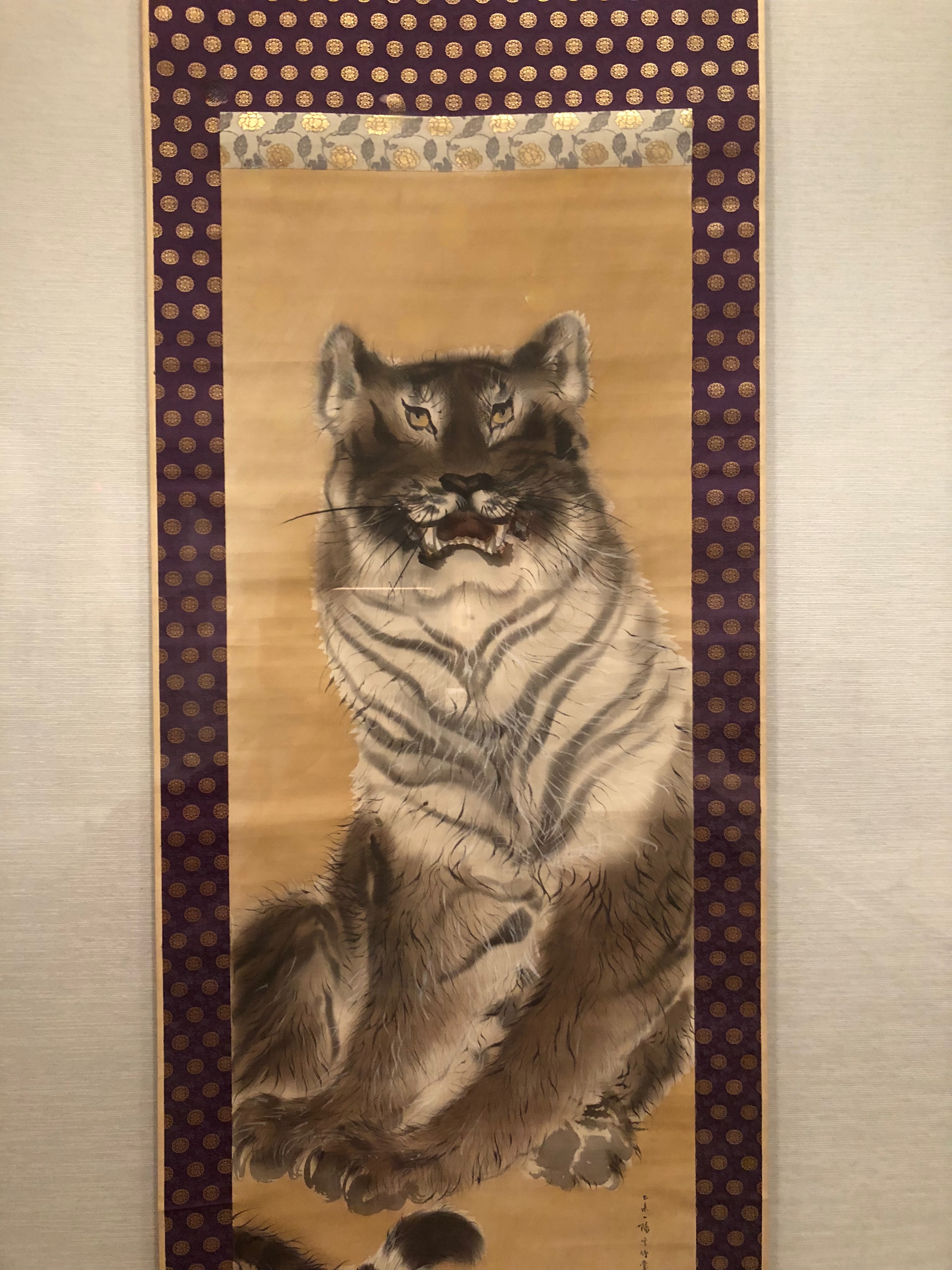
Art: Fierce Tiger Howling in the Wind – Kishi Chikudō’s Velvet Clawed Elegy

There’s a moment in this painting when you think: Is the tiger about to scream… or sigh? Kishi Chikudō’s “Fierce Tiger Howling in the Wind” straddles that wild line between menace and melancholy. You’re not looking at some National Geographic rendering here; this is a creature painted with too much soul to be just sinew and stripes. His ears are back, eyes a little glassy, jaw cracked open as though mid-growl or existential lament—possibly both. This tiger isn’t just howling at the wind; he’s probably howling at the imperial bureaucracy, the price of tea in Edo, or the general futility of existence. And in this moment, dear viewer, so are you.

The brushwork is restrained, even reverent. Fur rendered in thousands of small, fluttery strokes. Tail curling like an afterthought. The creature sits in glorious discomfort, almost regal in his unhappiness. If the Shijō school’s thing was infusing realism with poetry, Chikudō took that and said: “Sure, but what if the poem has teeth?” And what if those teeth are gnashing into a void of cultural anxiety and spiritual erosion? What if this tiger knows he’s art—and hates you for it?

Kishi Chikudō, Patron Saint of Emotional Carnivores

Kishi Chikudō (1826–1897) came from the bloodline of the Kishi school—a Kyoto-based offshoot of the Maruyama-Shijō style—where realism and lyrical brushwork met in something akin to visual chamber music. He wasn’t just painting animals; he was staging moral plays with fur. Chikudō became renowned for giving his tigers feelings. Not Disney feelings—complex, undiagnosed 19th-century neuroses.


He worked in a Japan caught mid-somersault between feudal ghosts and steam-powered futures, and his art became a kind of quiet resistance—brushes dipped in tradition, wielded against the rising tide of Western imitation. He studied the natural world the way a monk studies sin: not to avoid it, but to understand it deeply enough to reproduce it with spiritual exactness.

Japan in the Age of Awkward Transitions

The Meiji era (1868–1912) was Japan’s messy puberty—suddenly sprouting railroads and diplomatic petticoats, unsure whether to shave its samurai beard or lean into its Confucian cool. For artists like Chikudō, it was a time of aesthetic whiplash. The West wanted oil paintings and anatomical correctness. Japan had calligraphic tigers and metaphysical weather.

The tiger was a favored theme in Chinese painting, and by extension Japanese iconography, even though real tigers didn’t roam the islands (unless you count the metaphorical ones stalking the psyche). They symbolized strength, autonomy, and an untamed spirituality—all things Japan feared it might lose in the new constitutional shuffle. So this howling tiger becomes a furry, clawed avatar of the country itself: powerful, beautiful, sitting uncomfortably in its own skin, bellowing into a wind it didn’t summon and can’t escape.

 Or, Why This Tiger Might Just Be You

This is not a tiger on the hunt. It’s a tiger in reflection. A tiger who’s seen some shoguns come and go. He’s got bones in the closet and wind in his fur. You, too, might be this tiger: angry, majestic, misunderstood, and trying to maintain your dignity while everything around you is changing faster than a Ministry memo. He’s not howling at the wind because he’s lost. He’s howling because he knows exactly where he is, and that’s the problem.

So, real question: Are you the beast, the brush, or the wind?

#TigerWithIssues #ScrollGoals #ChikudōKnows #MeijiMood #AestheticSnarl #HowlAtTheWind #FurAndPhilosophy #BrushstrokeBreakdown #KyotoClawsBack #NotYourZooTiger #ExistentialStripeShow #ArtWithTeeth #ScreamInSilk #CulturalWhiplash #TigerTherapy

🎬 One Star to Rule Them All: The Beatniks (1959) and the Case of the Missing Beatniks

There are cinematic misfires, and then there is  The Beatniks,  a film so wildly off-target it could only have been named during a caffeine ...